

One of the most common reasons families hesitate before starting Oral Immunotherapy is the side effect profile. OIT works by gradually introducing increasing amounts of a food allergen to desensitize the immune system, and during that process — particularly in the up-dosing phase — reactions are not uncommon. Oral symptoms, gastrointestinal discomfort, and in a small percentage of cases, systemic reactions during dose escalations have led some families to pause before beginning a program that could otherwise transform their child’s safety and quality of life.
Emerging research is changing this conversation. A growing body of evidence suggests that lower maintenance doses of OIT — delivering far less allergen than conventional protocols — may achieve meaningful clinical outcomes with a significantly more favorable side effect profile. For many families on the fence about OIT, this research represents a practical path forward.
This article explains what the research shows, how lower-dose OIT differs from standard protocols, and what it means for Wisconsin families considering this treatment. If you’d like to discuss whether OIT is appropriate for your child and what protocol might fit your situation, our board-certified allergist Dr. Ringwala at Wisconsin Food Allergy is available for consultations
What Standard OIT Looks Like
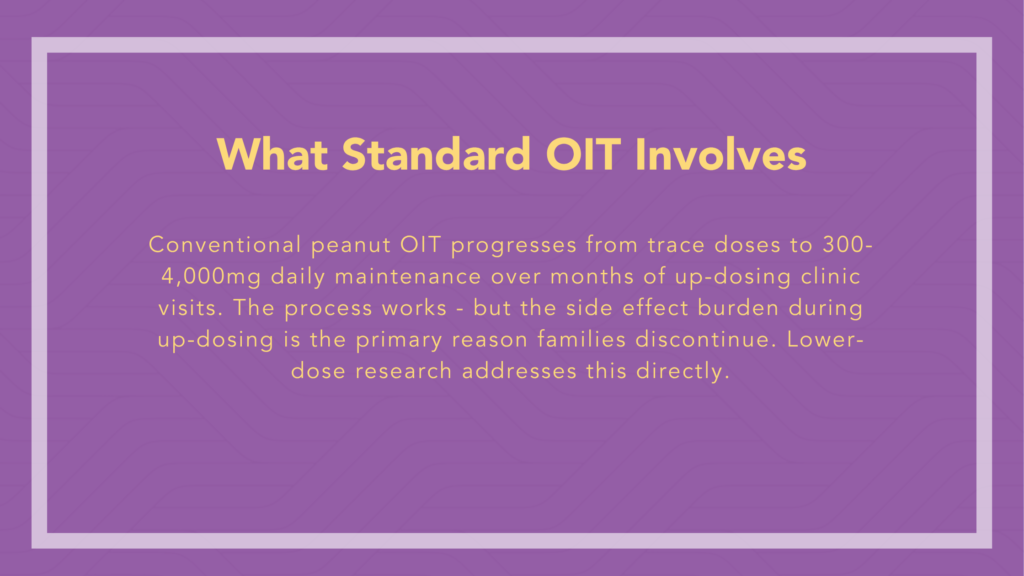
To understand lower-dose OIT, it helps to understand what conventional OIT protocols involve.
In a standard peanut OIT program — including the Palforzia protocol approved by the FDA in 2020 — the process has three phases:
Initial dose escalation: Conducted in clinic over a single day, this phase starts at a very low dose (typically 0.5-1mg of peanut protein) and increases to an initial home dose.
Up-dosing phase: Over the following months, the dose is gradually increased every two weeks, typically during a clinic visit where each new dose is administered and the patient is observed for 30-60 minutes. The Palforzia up-dosing phase proceeds through 11 dose levels, from 3mg up to 300mg of peanut protein.
Maintenance phase: Once the target maintenance dose is reached, the patient continues at that dose daily. For Palforzia, the maintenance dose is 300mg of peanut protein per day. For researcher-developed OIT programs, standard maintenance doses have historically ranged from 300mg to 4,000mg depending on the program.
Side effects are most common during the up-dosing phase when new dose levels are being introduced. Research published in JAMA Pediatrics and NEJM has documented that symptoms during the up-dosing phase of OIT — including oral symptoms, stomach pain, and in a small percentage of patients, systemic reactions requiring epinephrine — occur at meaningful rates.
This side effect burden is the primary driver of patient discontinuation from OIT programs.
What the Research on Lower-Dose OIT Shows
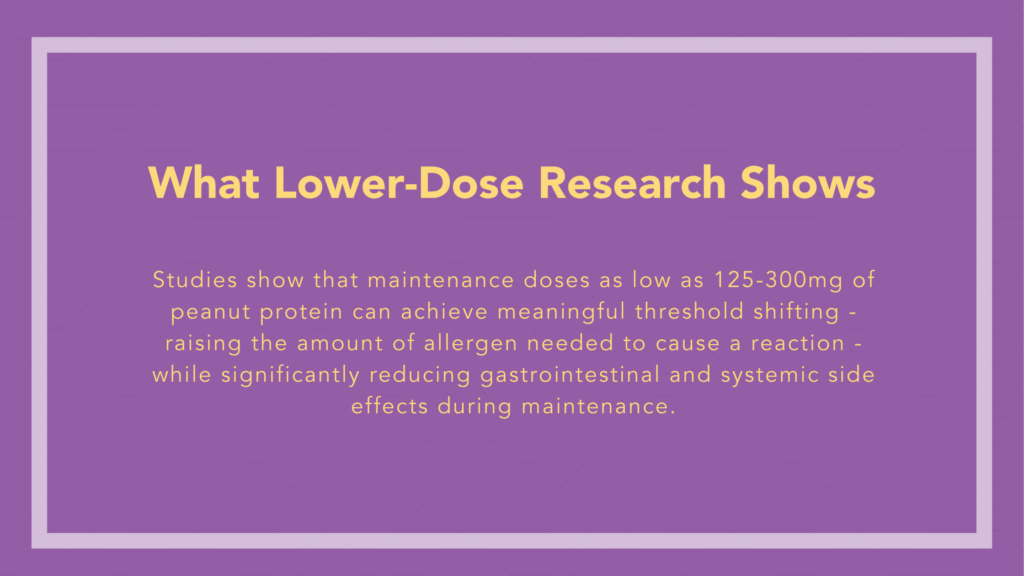
The question researchers have been asking is whether lower maintenance doses — doses significantly below the conventional 300-4,000mg range — can still provide clinically meaningful protection against accidental exposures while substantially reducing the side effect burden.
Several significant studies have addressed this question.
The case for 100-300mg maintenance
A study published in Allergy examined outcomes for peanut-allergic patients maintained at doses ranging from 125mg to 300mg of peanut protein. Researchers found that at these doses, a substantial proportion of patients achieved sustained unresponsiveness to doses well above their maintenance level — meaning the tolerance built during OIT persisted even when the daily dose was lower than what conventional protocols specified.
The critical insight from this research is that the relationship between maintenance dose and protection is not strictly linear. A patient maintained at 125mg does not have precisely half the protection of a patient maintained at 300mg. Immune tolerance, once built, has a degree of durability that doesn’t map neatly onto dose levels.
Reduced side effects at lower maintenance doses
Multiple studies have documented that patients on lower maintenance dose protocols experience significantly fewer side effects during the maintenance phase. Gastrointestinal symptoms — which are among the most common complaints in standard OIT — were substantially less frequent. Rates of systemic reactions during maintenance were also lower.
For families where side effects were a primary concern — particularly those with children who experienced significant gastrointestinal symptoms during up-dosing — lower maintenance dose protocols offer a different risk-benefit calculation.
The PRISM study and related research
The PRISM (Peanut Research in Subjects with Mild Allergy) research program and related work from academic centers including Stanford, UNC Chapel Hill, and Johns Hopkins has contributed to a broader understanding that OIT outcomes are not purely dependent on reaching the highest possible dose. Patient-centered outcomes — quality of life, reduced anxiety around accidental exposure, and practical safety for day-to-day living — can be achieved at a range of maintenance dose levels.
What “Clinical Benefit” Means at Lower Doses
It’s important to be precise about what lower-dose OIT does and does not accomplish, because this distinction matters for informed consent and for family expectations.
What lower-dose OIT is designed to achieve:
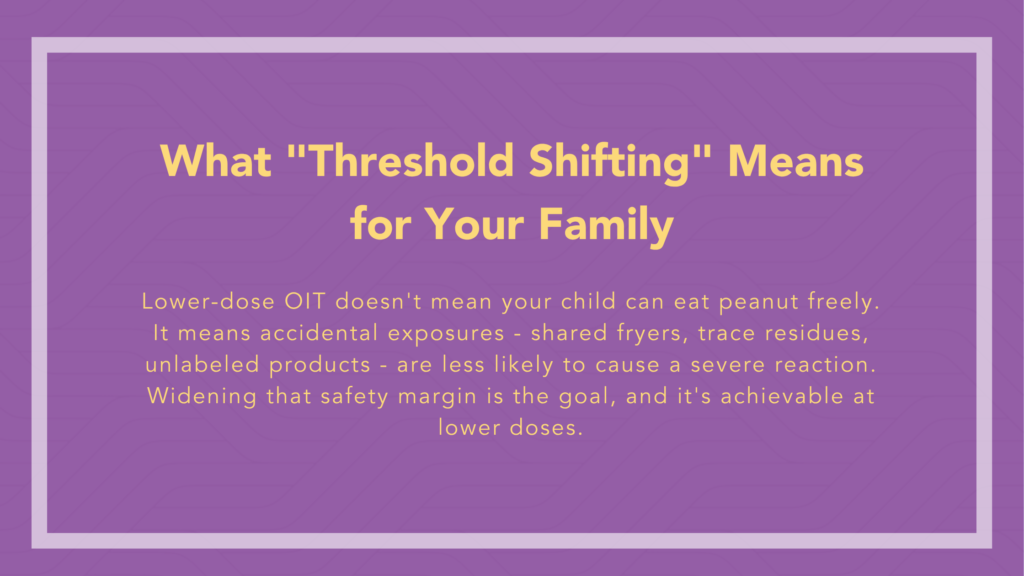
Lower-dose OIT aims to raise the threshold dose required to trigger a serious reaction. A peanut-allergic child who previously reacted to trace exposures — a peanut butter residue on a shared surface, a shared fryer, an unlabeled “may contain” product — may, after lower-dose OIT, be able to tolerate these accidental exposures without a severe reaction.
This is sometimes called “threshold shifting.” It does not mean the child can freely eat peanut-containing foods in any quantity. It means the margin of safety for accidental exposure has been meaningfully widened.
What lower-dose OIT is not intended to accomplish:
Lower-dose maintenance OIT is generally not positioned as a path to “outgrowing” peanut allergy or being able to freely eat peanut in any quantity without concern. That outcome — sometimes called full sustained unresponsiveness — requires higher maintenance doses and longer treatment duration, and it is not achievable in all patients even with conventional protocols.
Families considering lower-dose OIT should understand they are primarily gaining accident-proofing, not a cure. For many families, that outcome is exactly what matters most.
Who May Be Suitable for Lower-Dose OIT
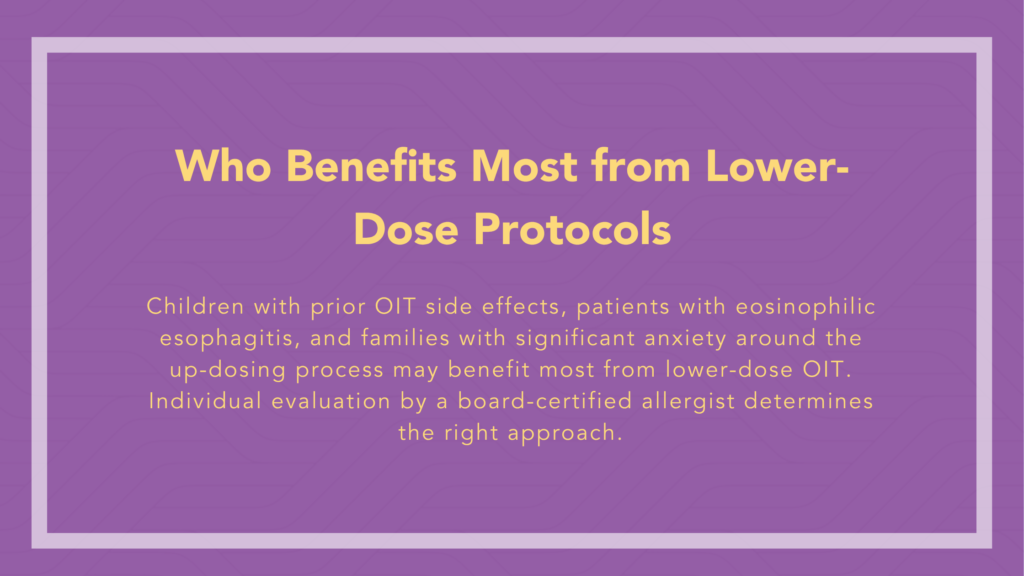
Not every patient is an appropriate candidate for lower-dose protocols, and not every patient who wants OIT will do better on a lower-dose approach. The decision involves careful evaluation of the patient’s specific clinical picture.
Patients who may benefit most from lower-dose protocols:
- Children who experienced significant side effects during a prior OIT attempt at conventional doses
- Patients with eosinophilic esophagitis (EoE) or a history of EoE, where high-dose allergen exposure may trigger esophageal inflammation
- Patients with significant anxiety around the OIT process, where a more gradual and lower-dose approach supports better adherence
- Families with practical constraints — significant travel distance to clinic, work schedules — that make frequent up-dosing visits challenging
- Patients who have had allergic reactions during prior up-dosing attempts at conventional dose levels
Patients for whom standard protocols may be more appropriate:
- Children who tolerated the up-dosing phase well and are motivated to reach full tolerance
- Patients who have already reached standard maintenance doses and are tolerating them
- Patients whose allergy profile and reaction history suggests they need a higher threshold shift to achieve meaningful protection
The clinical team at Wisconsin Food Allergy evaluates each patient individually to determine the most appropriate OIT protocol. There is no single answer that applies to every family, which is why individualized consultation matters.
How Lower-Dose OIT Fits Within Wisconsin Food Allergy’s Approach
Wisconsin Food Allergy’s approach to OIT is patient-centered and evidence-based. We do not apply a single rigid protocol to all patients. Instead, we evaluate each child’s allergy history, sensitization profile, reaction history, and family circumstances before recommending a protocol.
The growing evidence base for lower-dose maintenance has expanded the options available to Wisconsin families who previously felt that OIT’s side effect profile put it out of reach. We are able to discuss with families specifically:
- What dose range may be appropriate for their child’s specific situation
- How the up-dosing phase would be structured
- What side effects to expect and how they are managed
- What level of protection a given maintenance dose is likely to provide
- How to weigh the OIT option against SLIT (Sublingual Immunotherapy) as an alternative approach with a different risk-benefit profile
SLIT is an alternative to OIT that uses very small allergen doses delivered under the tongue rather than swallowed. It generally has fewer side effects than OIT and is appropriate for some patients, particularly younger children and those where OIT side effects have been a barrier.
Questions to Ask at Your OIT Consultation
If you are considering OIT for your child and want to discuss lower-dose protocols, here are productive questions to ask during your consultation:
- Based on my child’s specific IgE levels and reaction history, what maintenance dose range would you target?
- What side effects should we expect during up-dosing, and how are they managed?
- What happens if my child has a reaction during an up-dosing clinic visit?
- How would a lower maintenance dose change the protection we could expect against accidental exposure?
- How does OIT at a lower dose compare to SLIT for our situation?
- What does the commitment look like in terms of clinic visits, daily dosing, and duration of treatment?
Coming to a consultation prepared with these questions makes the conversation more productive and helps our team tailor the discussion to your specific needs.
The Bottom Line for Wisconsin Families
OIT remains one of the most meaningful advances in food allergy treatment in decades. The emerging evidence on lower-dose maintenance protocols makes it more accessible to families who have been deterred by side effect concerns — without fundamentally compromising the clinical benefit of the treatment.
If you or your allergist have discussed OIT before and side effects were a concern, this is a conversation worth revisiting in light of newer research. The field has moved, and options exist today that didn’t exist a few years ago.
Wisconsin Food Allergy offers OIT programs and consultations at our locations in Kenosha, Franklin, and Oshkosh. Our team will take the time to understand your child’s full clinical picture before making any recommendation.
Call us at 262-657-9390 or visit wisconsinfoodallergy.com to schedule a consultation.