
Peanut allergy is one of the most discussed food allergies in the United States — and one of the most misunderstood. Around every peanut allergy diagnosis comes a cloud of conflicting information: from well-meaning relatives who suggest that a small exposure won’t cause any real harm, to viral social media posts claiming that peanut allergies are overdiagnosed, to persistent myths about what schools, restaurants, and families can safely do.
This misinformation creates real danger. When parents, teachers, or caregivers operate under false beliefs about peanut allergy, children get put at risk — sometimes severely.
This article addresses the most common peanut allergy myths circulating among Wisconsin families and replaces each one with what the evidence actually shows. If you have questions about a specific situation or your child’s allergy profile, our team at Wisconsin Food Allergy is available for consultations at our Kenosha, Franklin, and Oshkosh locations
Myth 1: “A Small Amount Won’t Cause a Serious Reaction”
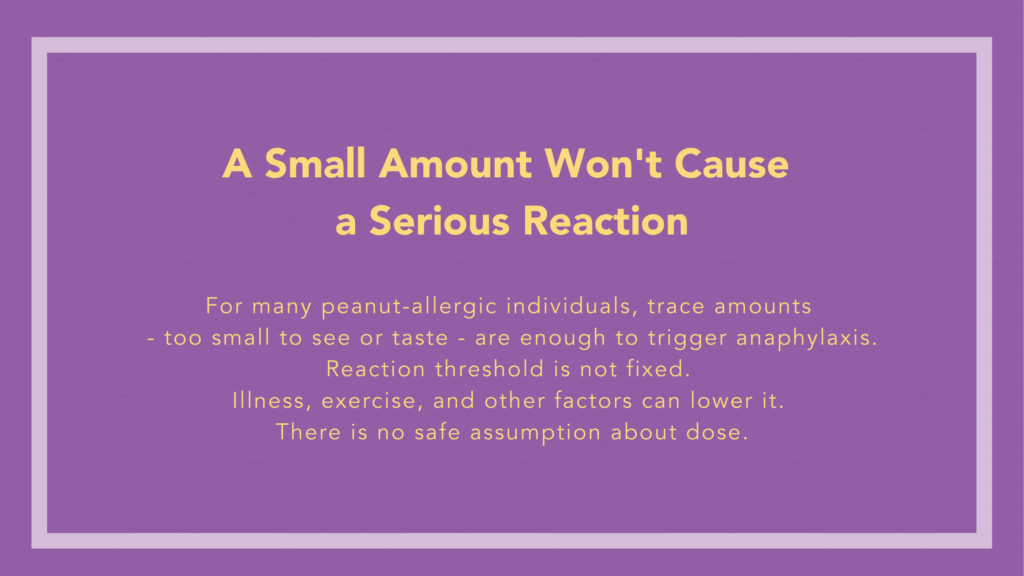
This is one of the most dangerous misconceptions in food allergy. The dose-response relationship for peanut allergy is not predictable in the way this myth implies.
The facts:
For many peanut-allergic individuals, trace quantities — quantities too small to see or smell — are sufficient to trigger anaphylaxis. Research published in peer-reviewed allergy journals has documented severe reactions to quantities measured in milligrams. The threshold dose varies considerably between individuals, but it cannot be assumed in advance without formal supervised testing.
Critically, a child’s threshold dose is not fixed. Factors including concurrent illness, exercise before or after eating, alcohol (in adults), and whether the allergen was consumed alongside other foods all influence reaction severity. A quantity that caused only mild symptoms last month may cause a more severe reaction under different conditions.
The risk of assuming a small exposure is safe is not worth taking. If your child has been prescribed an epinephrine auto-injector, it was prescribed because a serious reaction is a genuine possibility — not because it will never be needed.
Myth 2: “Children Almost Always Outgrow Peanut Allergy”
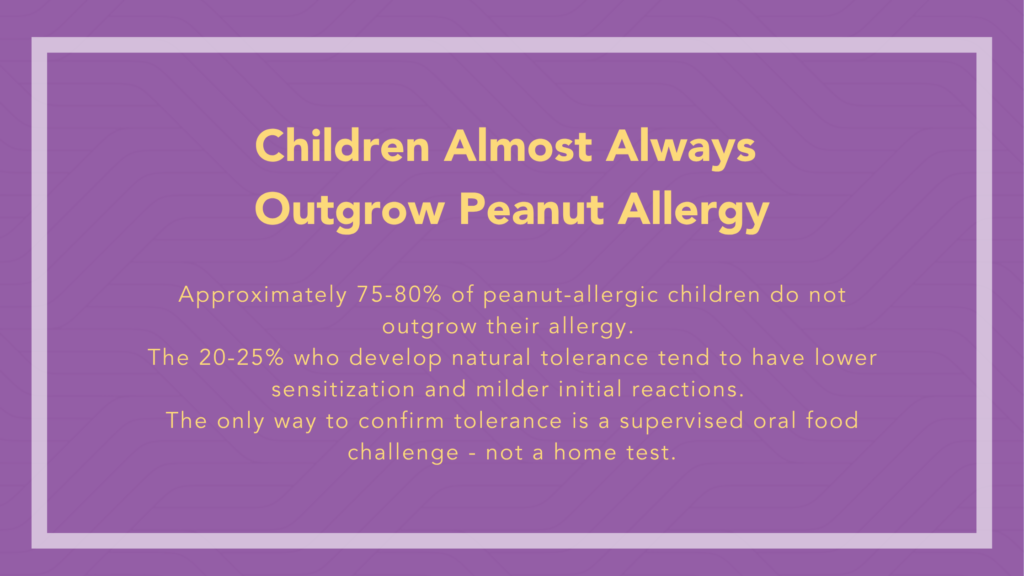
This myth conflates peanut allergy with milk and egg allergy, which children do frequently outgrow. Peanut allergy follows a fundamentally different pattern.
The facts:
Research from the Journal of Allergy and Clinical Immunology found that approximately 20-25% of children with peanut allergy do develop natural tolerance over time. This is a meaningful proportion, and it is a real possibility for some children. However, it means that roughly 75-80% of peanut-allergic children will carry their allergy into adulthood.
The subset of children most likely to outgrow peanut allergy typically have lower initial sensitization levels and milder initial reactions. Children with high levels of peanut-specific IgE and those who have experienced anaphylaxis are less likely to outgrow their allergy.
The only way to know whether your child has developed tolerance is through a formal supervised oral food challenge conducted by a board-certified allergist in a clinical setting equipped to manage reactions. Self-testing at home — giving a child peanut and watching what happens — is dangerous and not a medically acceptable approach.
Wisconsin Food Allergy can evaluate your child’s current sensitization levels and advise whether an oral food challenge is appropriate.
Do not assume your child has outgrown their allergy without professional evaluation.
Myth 3: “Peanut-Free Tables at School Completely Protect Allergic Children”

Peanut-free lunch tables are a visible and well-intentioned accommodation, and they do reduce exposure risk in specific, limited circumstances. But they do not provide comprehensive protection and should not be treated as a complete safety solution.
The facts:
Cross-contact with peanut allergens in school settings happens through multiple pathways — many of which do not involve the lunch table at all:
- Shared arts and crafts materials that have been in contact with peanut-containing food
- Classroom birthday celebrations and treats brought from outside
- Shared desks, pencils, books, and other surfaces touched after handling peanut-containing snacks
- After-school programs and extracurricular activities outside the cafeteria
- Field trips and school events where cafeteria protocols don’t apply
A peanut-free table reduces one specific exposure vector. A comprehensive school food allergy management plan — including a 504 Plan or individualized health plan, trained staff who know how to recognize and respond to reactions, and accessible emergency epinephrine — provides far more meaningful protection.
[Our team can help Wisconsin families understand their legal rights and develop effective school safety plans](INTERNAL: /contact). Federal law requires schools to make reasonable accommodations for students with food allergies, and Wisconsin families have specific rights under both IDEA and Section 504 of the Rehabilitation Act.
Myth 4: “If the Reaction Last Time Was Mild, the Next One Will Be Too”
This is a particularly widespread and particularly dangerous myth. Prior reaction severity is not a reliable predictor of future reaction severity.
The facts:
Allergic reactions to the same allergen can vary dramatically from one exposure to the next. The following factors influence severity independently of prior history:
- Total allergen dose ingested. A larger accidental exposure may cause a more severe reaction than a trace exposure.
- Cofactors present. Exercise, illness, NSAIDs (such as ibuprofen), and alcohol all lower the threshold for severe reactions and amplify severity.
- Route of exposure. In some patients, ingested allergen triggers more severe reactions than skin contact.
- Individual variation over time. Sensitization levels change, immune responses shift, and what caused a mild reaction at age 5 can cause anaphylaxis at age 10.
The AAAAI and FARE both explicitly state that prior mild reactions do not predict future mild reactions and that epinephrine should be available for all patients with diagnosed IgE-mediated peanut allergy regardless of their reaction history.
Myth 5: “You Can Smell a Peanut Allergy Reaction Coming”
The idea that strong peanut odors can trigger anaphylaxis is widespread but not well-supported by evidence. At the same time, the myth that peanut smell poses zero risk has its own inaccuracies.
The facts:
The overwhelming scientific consensus is that the airborne proteins from peanuts — the smell — are not sufficient to trigger systemic anaphylaxis in the vast majority of peanut-allergic individuals. The quantity of protein in peanut odor is far too small to reach the threshold required for an IgE-mediated systemic reaction.
However, this does not mean that proximity to peanuts is always without risk. Contact reactions — touching a surface where peanut butter has been present, then touching eyes or mouth — are a documented and real pathway to exposure. Children in close physical proximity to open peanut products have a higher risk of contact exposure than children who merely smell peanuts.
The practical takeaway: anxiety about peanut odor in an open space is generally not supported by the evidence. But physical cross-contact in shared spaces — shared tables, shared materials, close physical interaction — is a legitimate concern that schools and families should manage.
Myth 6: “Epinephrine Is a Last Resort — Try Antihistamines First”
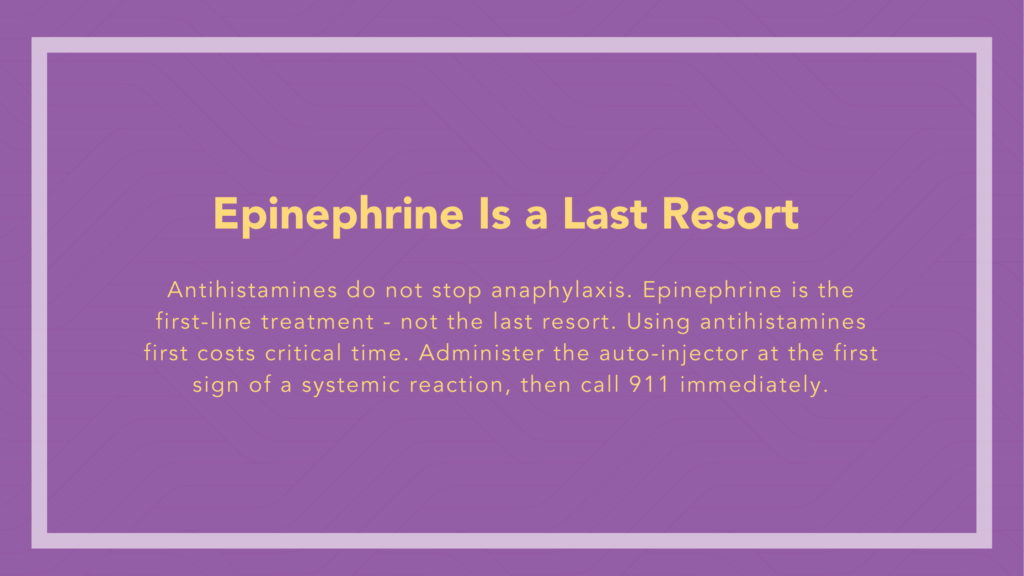
This myth contributes to delayed epinephrine administration, which is one of the most consistently identified factors in fatal and near-fatal food allergy reactions.
The facts:
Antihistamines (such as diphenhydramine/Benadryl) do not stop anaphylaxis. They can reduce skin symptoms like hives and itching, but they do not reverse the vascular and respiratory effects of a severe allergic reaction. Using antihistamines instead of or before epinephrine in a serious reaction costs critical time.
Both FARE and the AAAAI guidelines are unambiguous: epinephrine is the first-line treatment for anaphylaxis, not antihistamines. The auto-injector should be used at the first signs of a systemic reaction — difficulty breathing, throat tightening, hives spreading beyond the contact area, vomiting, dizziness. Do not wait to see if antihistamines resolve the symptoms.
After administering epinephrine, call 911 immediately. The epinephrine buys time — it does not end the reaction. Medical monitoring for a minimum of four hours is required because of the risk of biphasic reactions.
Review your child’s anaphylaxis action plan with their allergist annually to ensure you are clear on when to use the auto-injector. Wisconsin Food Allergy can review or update your child’s emergency action plan at any scheduled appointment.
Myth 7: “Peanut Allergy Tests Are Definitive
Positive Means Allergic, Negative Means Safe”
Allergy testing is a valuable clinical tool, but its results require interpretation by an experienced allergist. Raw numbers without context lead to both over-diagnosis and under-diagnosis.
The facts:
Skin prick tests and specific IgE blood tests measure sensitization — the presence of IgE antibodies to peanut proteins. Sensitization is necessary for allergy, but not sufficient for it. A positive test result indicates that the immune system has been exposed to peanut antigens and has developed IgE antibodies, but it does not confirm that eating peanut will trigger a clinical reaction.
False positive rates for food allergy testing are not trivial. A study published in the journal Pediatrics found that up to 50-60% of children with a positive peanut-specific IgE test in some populations were actually able to tolerate peanut in an oral food challenge.
Conversely, a negative specific IgE test does not guarantee tolerance, particularly in the setting of a documented prior reaction.
Component testing — which looks at specific peanut proteins such as Ara h 2 — provides more clinically useful information about whether sensitization is likely to reflect a genuine clinical allergy. Wisconsin Food Allergy uses component-resolved diagnostics to provide more accurate risk stratification for peanut-allergic patients. Book Your Appointment Today
Myth 8: “OIT Is Experimental and Not Safe for Children”
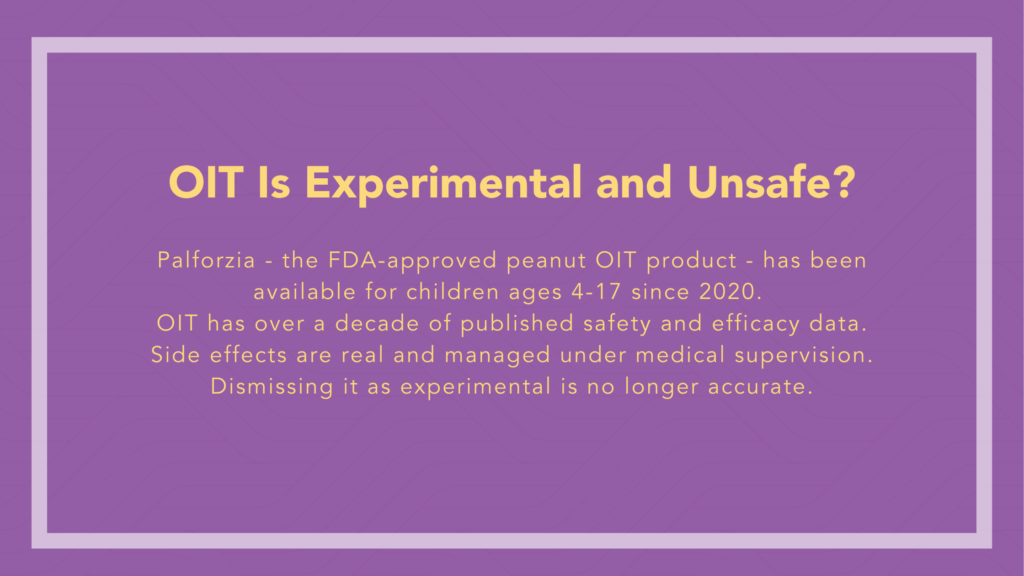
As Oral Immunotherapy has become more widely available and better studied, this myth has become increasingly inaccurate — but it persists, and it prevents some families from accessing a treatment that could meaningfully improve their child’s safety and quality of life.
The facts:
Palforzia, a standardized peanut OIT product, was approved by the FDA in January 2020 for children ages 4-17 with confirmed peanut allergy. It is not experimental. It has been through rigorous phase 3 clinical trials and meets the FDA’s standards for safety and efficacy.
Beyond Palforzia, peanut OIT programs using characterized peanut flour have been conducted at major academic medical centers across the country for more than a decade, with published long-term safety and efficacy data.
OIT does carry real risks — side effects during up-dosing phases are common and include oral symptoms, gastrointestinal complaints, and in a small number of cases, systemic reactions. This is why OIT is conducted under medical supervision and why patients always maintain access to epinephrine. But the risks of OIT are manageable and must be weighed against the risks of living with unprotected peanut allergy — including the ongoing risk of severe accidental exposure.
Wisconsin Food Allergy offers OIT and SLIT programs for qualified patients.
Our team can evaluate whether your child is a candidate and walk you through the process in detail.
Getting Beyond the Myths
Peanut allergy is serious, manageable, and increasingly treatable. The myths that surround it — from dismissiveness about small exposures to misconceptions about epinephrine — create real risk for real families.
The best thing Wisconsin parents can do is build their understanding on accurate information from a board-certified allergist rather than social media, hearsay, or outdated guidance.
Our team at Wisconsin Food Allergy is here to answer your questions, evaluate your child’s current allergy status, and help you navigate every aspect of peanut allergy management — from school plans and travel prep to treatment options.
Call us at 262-657-9390 or visit wisconsinfoodallergy.com to schedule an appointment.